

Carbon Sustainability
What is Net Zero?
Net zero refers to achieving a balance between the amount of greenhouse gas emissions produced and the amount removed from the atmosphere. (Institute for Government)
World temperatures are rising because of human activity and the emitting of greenhouse gases, with climate change now threatening every aspect of human life. Go to the BBC website for ‘What is climate change? A really simple guide.’
What is Net Zero and how can we get there? Click the button below and find out from the Energy Saving Trust:
Energy Saving TrustClimate Spiral showing temperature changes over the years The video in the link below shows how temperatures have increased over time and how rapidly in recent years.
Net Zero Carbon by 2030
MWH Treatment have a target to become operational Net Zero by 2030.
-
- This is a priority for us, as an organisation, as the effects of climate change are evident and will play an integral role in the future of the water industry. We also need to play our part in keeping the global temperature rise to below 1.50C, to comply with the Paris Agreement.
- Our target will support the Sustainable Development Goal 13 on Climate Action. The SDGs are a global urgent call to action from the United Nations.
- Our Net Zero Route Map shows the journey we must make to achieve this. A detailed action plan is in place - with consultation with fleet, procurement, commercial and construction currently taking place.
- We have specific requirements for our construction sites to follow - these are the Construction Site Carbon Requirements. These include electricity and water monitoring, use of eco-accommodation, use of battery powered plant, use of renewables and hybrid generators, use of HVO fuels from recycled sources and electric vehicle charging points
MWH Treatment Carbon Footprint
A carbon footprint measures the total greenhouse gas emissions caused directly and indirectly by a person, organisation, event or product.
The Carbon Journey so far
What does the MWH Treatment Carbon Footprint include:
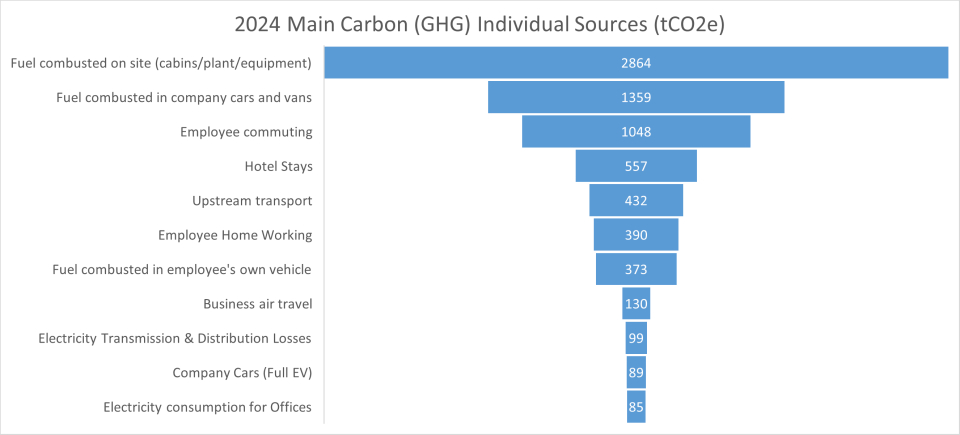
The MWHT carbon footprint is calculated annually and verified by the Achilles Carbon Reduce Scheme. In 2024, over 37% of our carbon footprint was the direct fuel use on our construction sites - for powering site accommodation, non-road mobile plant and equipment. The graph shows the main carbon emission sources of our carbon footprint.
 View our Carbon Journey
MWH Treatment Carbon Footprint - the details…
MWHT has calculated its organisational carbon footprint for the last 10 years (see award), We reduced carbon emissions during a 5 year period (2015-2019) and achieved a 35% reduction in emissions intensity, as well as a 41% reduction in absolute total emissions surpassing our original targets.
For 2020 a new baseline (2017 - 2019 average baseline) was set to reflect the MWH Treatment ambition to be operational Net Zero Carbon by 2030. The target set was to reduce our carbon footprint by a further 20% (emissions intensity - tonnes of CO2e emitted per £1m turnover) by 2025. From the graph on the right you can see we are not on track to achieve this, which is why we have targeted carbon emissions from our construction sites - as these are the biggest source of emissions.
However when comparing MWHT's total carbon emissions produced - we have actually increased emissions by 2.8 times since 2020. This is due to various reasons including growth of the company, data quality improvements and inclusion of hotel stays, commuting, home working and upstream transportation. This highlights how MWHT need to make significant strides in reducing our emissions and finding innovative solutions and efficiencies.
Further information on the MWHT carbon footprint for 2022 are detailed in the Achilles Carbon Reduce programme Summary Report and Certificate.
MWHT Organisational Carbon Reduction Measures
- Use of Teams for calls and video conferencing to avoid travel.
- Review of van tracker data including driving behaviours and rewarding good performance.
- Implementation of Green Travel Plans for all offices.
- Since mid-2021 there are only hybrid or electric vehicles for selection. Check out our Fleet page on Connect.
- Construction Carbon Smart Toolkit available with guidance, posters, checklist and toolbox talks.
- Guidance notes available on Fuel Efficiency for Vehicles and Maximising Fuel Economy.
- Established a Home Working and Office Sustainability Toolkit and a specific Home Working Sustainability Toolkit Connect page.
- Encourage use of trains and public transport over driving and flying through following the travel hierarchy.
- In 2023 MWHT diverted 99.7% of materials and waste from landfill.
- Use of HVO fuels throughout our regions, which commenced following a trial on a Severn Trent site. There is a guidance note on HVO detailing the MWH Treatment approach as we will only purchase those from certified sources and preference for HVO from recycled vegetable oils. HVO fuels are beneficial as they release significantly less carbon dioxide than gas oil.
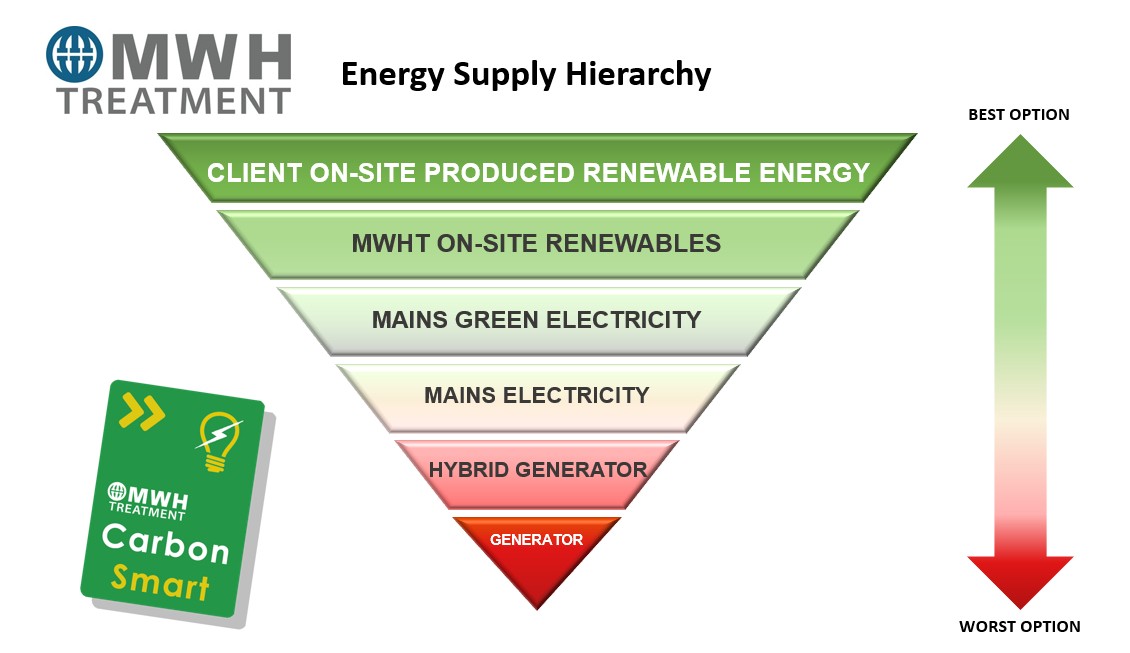
Energy Supply Hierarchy
- Low carbon solutions for our site set-ups, compounds and welfare facilities are detailed on the ‘Construction Site Carbon Requirements’ page, including:
- Only eco-accommodation allowed and preference on the use of electric plant.
- Use of a solar powered pod as a source of power for site welfare facilities, external lighting and a transformer for charging small tools. This saved 9,720 litres of fuel.
- Use of hybrid generator rather than a traditional generator resulting in a reduction in generator run-time and emissions. Saved approximately £1,900 of fuel costs. See guidance note on hybrid generators.
- Solar Loos running off solar power with LPG.
- MWHT Direct (Severn Trent) are using a Solar Welfare van which saves costs on fuel.
- For further information on these also see the Environmental Best Practice on ‘Low Carbon Innovative Solutions on Site’.
Collaboration with our Supply Chain
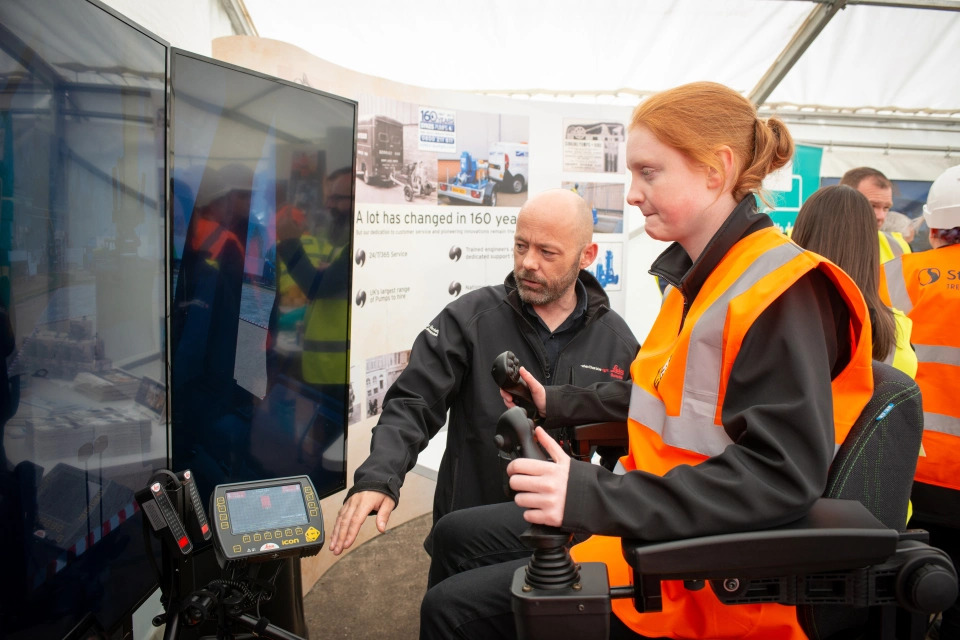
- Working with framework PPE and site equipment provider, Greenhams, to trial two-a-week deliveries (instead of next day) within our north west region.
- PPE selection has considered sustainability requirements, moving to Safety Boots and Safety Glasses providers that have recycled content and lower environmental impact.
- Promotion of green equipment options with plant providers Speedy and GAP.
- Established a Carbon Management Plan with Speedy and ongoing actions to reduce fuel usage.
- Monitoring idling times of non-mobile plant through Ardent Plant Hire.
- Fenns, framework stationery provider, substitute core items with sustainable alternatives.
- Further discussions are being held with our supply chain to reduce carbon and improve sustainability.
RSK and MWH Treatment Science Based Targets
RSK and MWH Treatment Science Based Targets
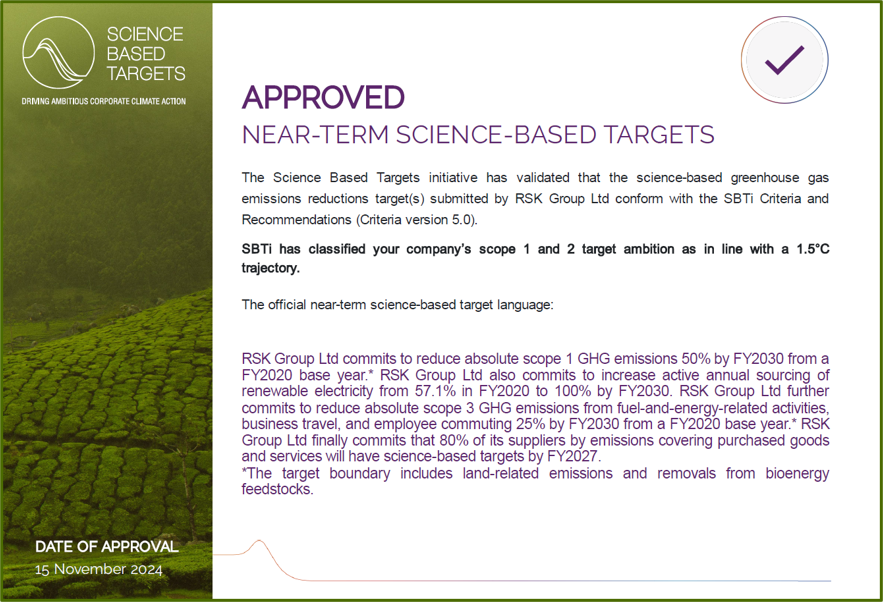
The Science Based Targets initiatives (SBTi) is a global collaboration between the CDP (Carbon Disclosure Project), UN Global Compact, World Resources Institute (WRI) and the World Wide Fund for Nature (WWF).
The SBTi aims to ensure that a business's carbon targets are aligned with the goals of the Paris Agreement. The Agreement seeks to limit global warming to well below 2 degrees above pre-inductrial levels and pursue efforts to limit it to 1.5 degrees.
RSK Group has committed to the SBTi on behalf of the companies that sit within the group. SBTi have classified RSK Group's scope 1 and 2 target ambition in line with a 1.5 degree trajectory.
Our near-term science-based targets are to:
1. Reduce absolute scope 1 GHG emissions 50% by FY2030
2. Increase annual sourcing of renewable electric to 100% by FY2030
3. Reduce absolute scope 3 GHG emissions from fuel-and-energy-related-activities, business travel, and employee commuting 25% by FY2030
There are also a supplier engagement target which MWHT are currently reviewing to determine approach.